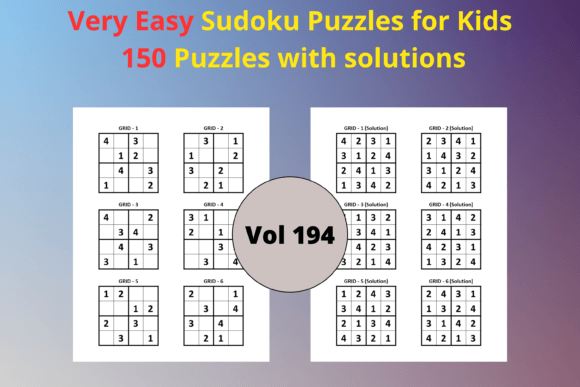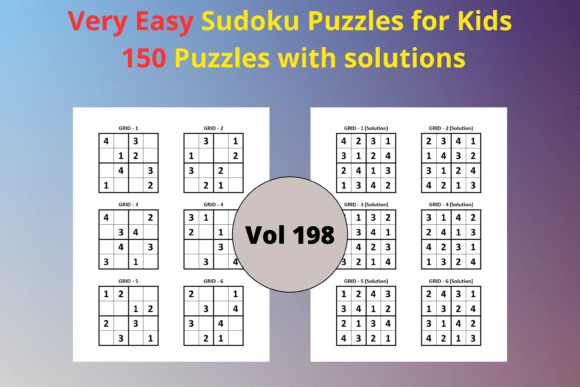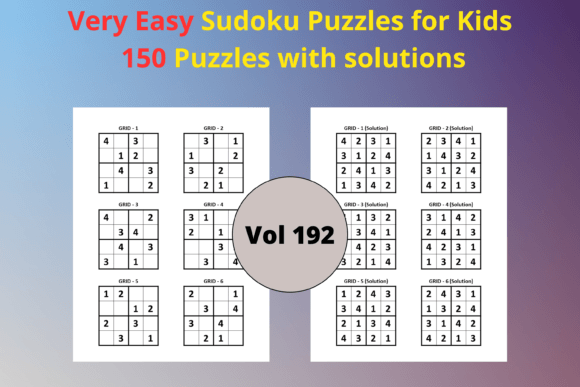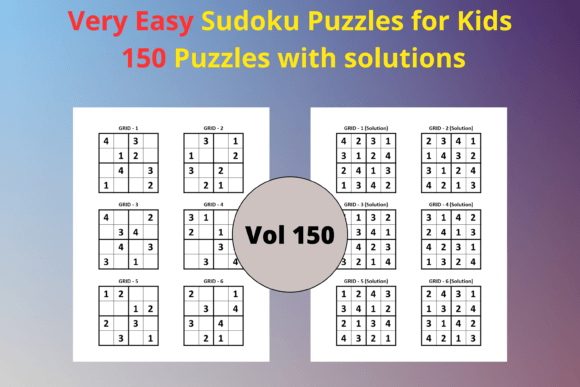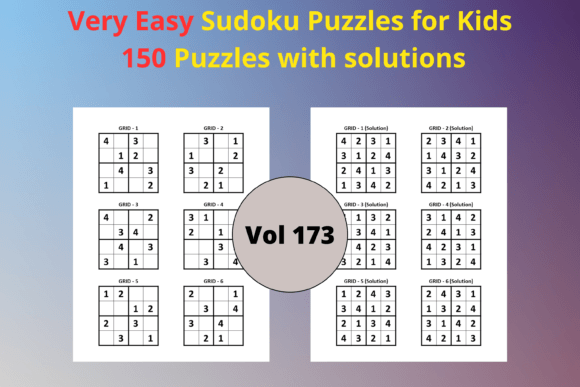
Very Easy Sudoku for Kids 173: 150 Simple Puzzles That Little Learners Love
You know that moment when a young child solves something all on their own and their face lights up with pride? That’s exactly the kind of experience this pack is built around. Very Easy Sudoku for Kids 173 gives you a complete, ready‑to‑use collection of 150 different 4×4 Sudoku puzzles and their matching solutions, all designed for children who are just starting out with logic games. Think of it as a gentle on‑ramp to critical thinking that doesn’t overwhelm a preschooler or kindergartener. The pages are clean, the instructions are minimal, and the whole thing is sized at a familiar 8.5×11 inches—ideal for little hands and standard printers.
What sets this apart from a generic puzzle book is that it comes as a dual‑format download. You get a print‑ready PDF you can upload straight to Amazon KDP, or send to your local print shop without any technical headaches. You also get an editable PPTX file, which means you can adjust colors, swap out elements, or add your own branding before sharing with students, clients, or your own kids. It’s not just a pile of puzzles; it’s a flexible resource you can shape around your exact situation, whether you’re a self‑publisher looking for a new activity book interior, a teacher building a quiet‑time corner, or a parent who wants weekend brain‑boosting fun without screen time.
Why 4×4 Sudoku Is the Perfect Starting Point for Young Children
A standard 9×9 Sudoku grid can feel like a mountain to a five‑year‑old. But shrink that grid down to four rows and four columns, and suddenly everything clicks. Kids work with just four numbers—usually 1 through 4—and each row, column, and 2×2 block needs exactly one of each. The logic is the same, but the cognitive load shrinks dramatically. A child can finish a single 4×4 puzzle in two or three minutes, which keeps frustration low and motivation high. That quick win matters. It tells a kid, “I can figure things out,” and they’re more likely to reach for the next puzzle on their own.
The very easy difficulty level in this pack is intentional. None of the 150 puzzles require guesswork or advanced scanning techniques. Every grid can be solved with simple reasoning—looking at what’s missing in a row or a block—so even a child who has never seen Sudoku before can understand the rules after a one‑minute demo. Because the puzzles rely on logic, not reading ability, they work well for English language learners and children at different developmental stages. Teachers and therapists often grab 4×4 Sudoku for its quiet, calming effect on active minds, and this collection gives them more than enough variety to keep the activity fresh for months.
Launching a Children’s Activity Book on Amazon KDP Without the Design Grind
If you publish low‑content books on Amazon, you know exactly how much time goes into formatting. Margins, bleed settings, and trim size errors can turn a simple interior into a frustrating back‑and‑forth. With Very Easy Sudoku for Kids 173, most of that heavy lifting is already done. The PDF is sized precisely for an 8.5×11 inch trim—one of the most common formats for kids’ workbooks—and the puzzle pages are laid out so that the solution pages don’t accidentally fall on the back of a puzzle. You can upload the PDF directly to KDP, set your cover, and have a legitimate, marketable book ready in less than an hour.
Even better, you’re not buying just any old puzzle file. You’re getting 150 unique puzzles, which gives your book enough pages to feel substantial but not so many that print costs eat into your margins. Parents browsing for “kids sudoku book 4x4” or “easy logic puzzles for preschoolers” will see a complete product they can trust. The fact that it’s a physical, print‑ready interior means you skip the “I’ll design it myself” delay and move straight to the part that makes money. One creator I know used a similar pack to build a three‑book series—farm animals, space, and unicorn themes—simply by changing the cover and adding themed decoration around the grids via the editable PPTX. That’s the kind of real‑world reuse that turns a single purchase into multiple revenue streams.
How Teachers and Homeschoolers Turn Quiet Time into Brain Time
Every teacher has that one drawer or bin labeled “early finishers.” The trick is filling it with activities that don’t require constant check‑ins or adult explanation. Sudoku slips right into that slot. You can print the puzzles ten to a stack, staple them, and let kids grab a booklet when they’ve wrapped up their math or reading work. Because the 4×4 grids are so manageable, a child who finishes early won’t need you to pause a small‑group lesson just to explain a new game. They already know the drill: fill in the missing numbers, no repeats in any row, column, or box.
Homeschool parents face a similar rhythm challenge. When you’re teaching multiple ages at the kitchen table, the older kid needs twenty minutes of focused attention while the younger one fidgets. That’s when a printed Sudoku sheet, a pencil, and a quiet corner become incredibly valuable. The puzzles in this pack don’t involve any cutting, gluing, or messy setup. Print a fresh batch on Sunday evening, and you’ve got a week’s worth of independent brain work ready to go. For even more mileage, slide a few sheets into dry‑erase pockets. Kids can solve them with markers, wipe them off, and pass them along. It makes the 150‑puzzle count stretch across an entire semester without wasting paper.
Parents on the Go: Screen‑Free Entertainment That Actually Helps Development
The restaurant table, the doctor’s waiting room, the long car ride to Grandma’s—these are the moments when a tablet or phone tends to appear before anyone even asks. Very Easy Sudoku for Kids 173 gives you a calm alternative that doesn’t require charging or data. You can print a handful of puzzles, clip them to a small clipboard, and keep them in the car door pocket. When the “I’m bored” chorus starts, you have something that engages the logical part of the brain without the sensory overload of an app.
What makes this work better than a random coloring page is the built‑in sense of achievement. A coloring page is open‑ended; a Sudoku puzzle has a clear finish line. When a child places that final number correctly, they know they solved it, and that feeling lands differently than simply staying busy. Parents often notice that after a couple of puzzles, kids are calmer and more willing to shift into quieter activities afterward. It’s not a magic wand, but it’s a reliable tool. And because the pack includes solutions, you can hand a child the answer key and let them self‑check—turning a moment of potential “Is this right?” anxiety into an independent review.
Customizing and Repurposing the PPTX File for Different Settings
The editable PowerPoint file is where things get genuinely interesting for small business owners, tutors, and crafty parents. Maybe you’re a learning center that wants to brand each worksheet with your logo and a specific color palette. Open the PPTX, drop your logo onto a corner, and export as a new PDF. Maybe you’re a blogger creating a free printable library for subscribers; you can take a handful of puzzles, add a simple instruction box with your website link, and create a lead magnet that fits your audience’s needs. The puzzles themselves remain the same, but the wrapper adapts.
Another practical use is creating progressive difficulty packs. Even though all 150 puzzles are very easy, you could group them by the number of given clues or by how quickly a typical child solves them, then label the sets “Starter,” “Confident,” and “Super Solver.” Add a certificate at the end of each level and you’ve got a structured program that feels bigger than a single book. Tutors who work one‑on‑one with young learners use this approach to track progress and celebrate milestones. The editable file gives you the freedom to make these adjustments without any graphic design software beyond PowerPoint, which most people already have installed.
What to Consider Before You Download This Puzzle Pack
No resource is right for every situation, so let’s talk through a few practical checkpoints. First, think about the age and skill level of the actual users. While the puzzles are labeled “very easy” and use a 4×4 grid, a child who has just turned four may still need someone sitting next to them for the first few tries. The puzzles are simple, but “easy” is relative. If you’re creating a book for three‑year‑olds, you might want to pair these puzzles with larger visuals or simpler fill‑in activities to round out the book. For five‑ and six‑year‑olds, the difficulty hits a sweet spot where they can work mostly independently.
Second, if your goal is KDP publishing, double‑check that your printer or distributor’s trim requirements align with the 8.5×11 inch format. Most do, but it’s always wise to verify margins and make sure the PDF’s page count matches what you intend to list. The ready‑to‑upload claim holds true for a straightforward KDP paperback; if you’re formatting for IngramSpark or a different service, you might need to tweak the PPTX to match their specific bleed settings. Also consider whether you need interior pages to be one‑sided or two‑sided. The provided files are designed for two‑sided printing, but you can easily intersperse blank pages in the PDF if you prefer single‑sided puzzles for a classroom setting.
Why Simple Features Lead to Real Results in Daily Life
It’s easy to look at a pack of Sudoku puzzles and think, “It’s just a grid with numbers.” But the real value shows up in how people actually use it. A dad prints ten sheets on a Tuesday morning, and by lunch his daughter has solved four and proudly shows her work. A teacher runs off thirty copies before school starts, and her most wiggly student sits focused for fifteen unexpected minutes. A KDP publisher uploads the file, pairs it with a cheerful animal cover, and by the weekend the book is live, earning a few extra dollars a month without any hand‑holding. These aren’t hypotheticals—they’re everyday outcomes when a product is genuinely plug‑and‑play.
The combination of the 4×4 grid and the “very easy” logic level removes barriers that usually trip up kids’ activity products. There’s no reading required, no complex multi‑step directions, and no decisions to make about something already solved. The solutions eliminate guesswork for adults, and the editable file invites customization without locking you into someone else’s design vision. When a resource hits that balance—structured enough to work immediately, flexible enough to adapt—it tends to become a repeat purchase or a go‑to recommendation. That’s the quiet strength of Very Easy Sudoku for Kids 173. It doesn’t try to be the flashiest product on the shelf; it just does exactly what you need it to do, reliably, whenever you reach for it.