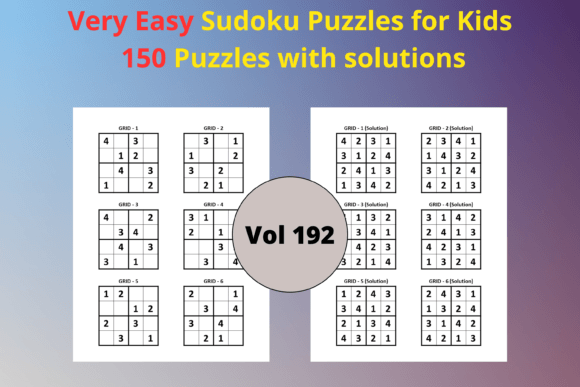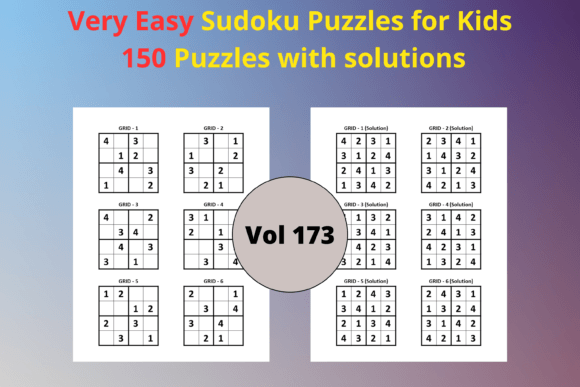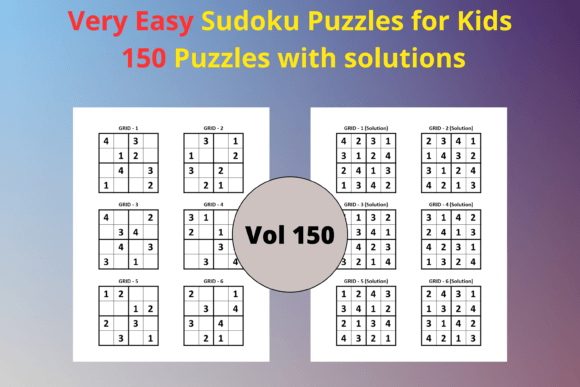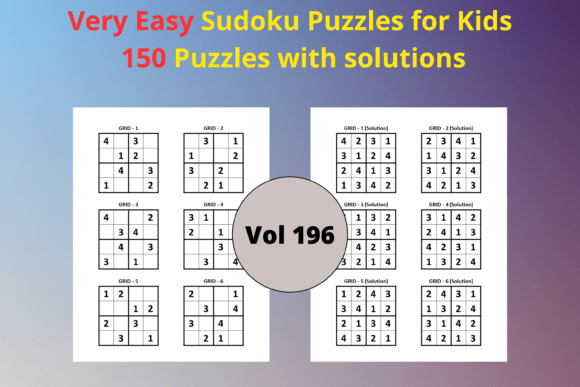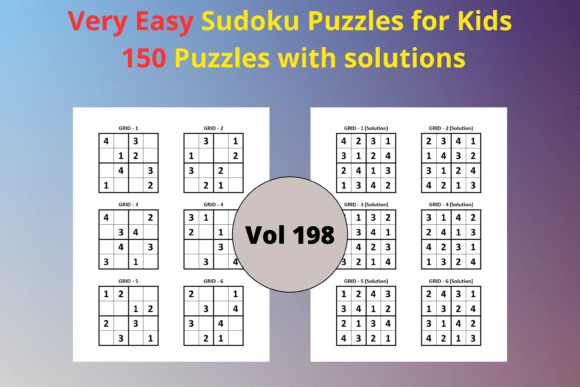
Very Easy Sudoku for Kids 198: Simple Puzzles, Big Possibilities
You already know that Sudoku is a brilliant brain game. But when you find a resource called Very Easy Sudoku for Kids 198 — a ready-to-use pack of 150 different 4x4 puzzles with solutions, delivered as both a print-ready PDF and an editable PPTX — you aren’t just getting an activity book. You’re getting a flexible, creative toolkit that can be shaped into educational moments, playful products, and fresh content in minutes.
These aren’t grid-heavy 9x9 puzzles that overwhelm young minds. They are deliberately very easy 4x4 Sudoku puzzles for kids, built with large spaces, friendly logic, and enough repetition to build confidence. Each puzzle uses numbers 1 through 4. The grid is small, the clues are generous, and the satisfaction is instant. The pack includes 150 unique puzzles and an equal number of solution pages, all sized at 8.5 x 11 inches and ready for commercial use in KDP interiors, printable bundles, classroom materials, or digital products.
Why Very Easy Sudoku for Kids 198 Stands Out
Plenty of puzzle packs promise simplicity but end up frustrating a child who is still learning to hold a pencil. What makes this collection different is the intentional design around a true very easy level. Each puzzle typically features 6 to 8 pre-filled numbers. That leaves only 8 to 10 empty cells for the child to complete. No guessing, no tears. Just a calm, logical path from start to finish.
The value goes beyond the puzzles themselves. Because you receive both a flattened PDF (perfect for uploading straight to Amazon KDP or sending to a printer) and a fully editable PPTX file, you aren’t locked into one look. You can change the title, add your own branding, modify the instructions, or even translate the text into another language. That editing power turns a simple activity pack into a seed for a much larger creative project.
Creative Ways to Use Your Puzzle Pack
Instead of seeing 150 puzzles as a single book, think about all the directions you can take them. Educators, parents, creators, and small publishers will each find a different entry point.
1. Build a Graduated Puzzle Experience
Even within the very easy level, you can sequence the puzzles. Arrange them so that the first 30 have the most pre-filled cells, and the last 30 have slightly fewer, nudging the child just beyond their comfort zone without ever feeling too hard. Tuck a positive message or a small coloring element between every few puzzles. Suddenly, you have a progression that mirrors how real skill develops.
2. Create Themed Activity Kits
Pair 10 puzzles with mazes, dot-to-dot pages, and a simple word search. Add a cover, theme the package around animals or space or fairy tales, and you’ve got a charming low-content product for Etsy or a classroom reward. The editable PPTX lets you drop themed backgrounds behind the Sudoku grids — just make sure the numbers stay crisp and legible.
3. Design Family Game Night Printables
Print several copies of the same puzzle and challenge siblings to a gentle race. Laminate a few sheets and use dry-erase markers for repeated play. The instant feedback of a right answer keeps the mood positive. Combine the 4x4 puzzles with simple timer games: “Can you solve this before the music stops?”
4. Transform Puzzles into Digital Content
Export individual puzzles from the PPTX as PNG or JPEG files and drop them into an app, a slideshow, or a tablet-friendly PDF. Parents love screen-free activities, but a well-designed interactive PDF that lets kids tap and fill cells can bridge the digital-physical gap gracefully.
Customizing and Branding the Editable Files
The PPTX file is your creative playground. However, the goal isn’t just to edit — it’s to edit in a way that feels intentional and trustworthy to your audience. When you open the file, you’ll find clean, ungrouped elements that you can resize, recolor, or move without breaking the puzzle logic.
Practical tips for branding without clutter:
- Add your logo or website subtly in the footer area, not inside the puzzle grid.
- Keep the font of the instruction text simple and readable — rounded sans-serif typefaces suit child audiences well.
- If you change colors, test print a page in grayscale. Many customers will print at home on a black-and-white printer, and your puzzle cells must still be clearly visible.
- Use the master slide function to apply a consistent layout across all 150 puzzle pages in minutes.
Remember that very easy Sudoku for kids depends on clarity. Over-decoration can distract a young solver. A soft pastel border or a small character icon in a corner is often enough to delight without overwhelming.
Adapting for Different Audiences and Platforms
This pack is not just for KDP publishers. It has wide reach when you match the format to the user’s specific goal.
For the parent and homeschool educator: The 8.5 x 11 inch size works beautifully in a binder. Print the puzzles and slip them into plastic sleeves. Place the solution pages in the back. The child can self-check their work, which builds independence. You can also intersperse the Sudoku puzzles with handwriting practice or number tracing — the 4x4 grid size naturally keeps everything compact.
For the small business owner or freelancer: Use the puzzles as a lead magnet. Give away 10 printable 4x4 Sudoku pages in exchange for an email address. Because the puzzles are very easy, they appeal to a wide age range — from preschool to early elementary — which makes the lead magnet universally relevant to parents. The fact that you can brand the PDF increases brand recall long after the download.
For the designer and creative professional: Think beyond paper. Pull the puzzle structure into a birthday party activity booklet, a restaurant kids’ menu, or a waiting-room play sheet. The editable PPTX means you can export puzzle shapes as separate assets and integrate them into your own layouts. The logical structure of a 4x4 grid also adapts well to non-number themes — replace 1-4 with colors, animals, or shapes for an entirely new experience.
Practical Tips for a Professional Finish
Whether you upload to KDP or share a printable PDF via a course platform, quality matters. Keep the following in mind:
- Check the margins: The 8.5 x 11 inch layout works for full bleed if you extend backgrounds, but leave at least 0.375 inches of safe space inside the trim edge. No number or puzzle line should sit near the edge.
- Use high-resolution output: When exporting PDFs from PowerPoint, make sure images and vector shapes export at print quality (300 DPI). This keeps the grid lines sharp and the numbers crisp.
- Maintain contrast: If you tint the puzzle background, keep it light. A fill of 5–10% pastel blue or peach adds warmth without straining the eyes. The grid lines should remain solid black.
- Preview on an actual tablet: If the PDF is for tablet use, test it on a screen. The touch targets should be large enough for small fingers; 4x4 Sudoku cells are already generous, but spacing around the grid prevents accidental taps.
Making Learning Fun: Educational Applications
Very easy Sudoku isn’t just about numbers. It teaches scanning, attention to detail, and the elimination process that underpins early math reasoning. Teachers and therapists can use these puzzles in brilliant, understated ways.
Occupational therapy twist: Place the puzzle on an easel board or a slanted surface to encourage proper wrist positioning while writing. Use a chunky pencil or a high-contrast marker for children who need extra visual support.
Language-integrated exercises: In a bilingual classroom, add the words “row,” “column,” and “missing” in both languages next to the grid. The repetition of those terms within a game format accelerates vocabulary acquisition.
Social-emotional learning: After solving a puzzle, ask the child: “How did you feel when you found the missing number?” Acknowledge the small victory. This is a strategy often used by child psychologists and special education teachers who understand that puzzle mastery quietly builds a growth mindset.
Commercial Ideas for Small Business Owners and Publishers
The KDP low-content space is competitive, but very easy 4x4 Sudoku for kids remains a reliable evergreen niche. The key is to present the familiar puzzle in a way that feels fresh and targeted.
- Series by age: Create books titled “4-Year-Old’s First Sudoku,” “Toddler Brain Games,” or “Preschool Logic Puzzles.” The very easy difficulty aligns perfectly with the abilities of children ages 3–6.
- Holiday and seasonal editions: Edit the PPTX to add Valentine’s hearts, Halloween pumpkins, or winter snowflakes behind the grid. These small seasonal details increase purchase intent during key shopping months.
- Bundle offers: Combine the 150 puzzles with mazes, coloring pages, and letter tracing sheets. Sell as a “Kindergarten Readiness Kit” or a “Quiet Time Activity Pack.” Bundles increase your average order value without requiring you to create each component from scratch.
- Sub-license content: Because you can edit and rebrand the file, you can offer puzzle pages as PLR (Private Label Rights) content in your own membership or store. Respect the original terms, but use your editability to create a unique version that serves your community.
How to Keep Your Output Consistent and Original
When you have 150 puzzles, it’s tempting to dump them all into one book and call it done. Audiences notice and reward effort. A more curated approach often yields better reviews and repeat customers. Consider these actions:
- Write a genuine welcome note: One warm paragraph at the beginning of your book from “Auntie Lisa” or “Mr. Rob” sets a tone no generic interior can replicate.
- Number the puzzles clearly: Children love to see progress. Even simple “Puzzle 1 out of 150” gives a sense of journey. For the solution section, mirror those numbers exactly. Your audience will appreciate the smooth pairing.
- Leave breathing room: Instead of cramming two puzzles on one page, let one 4x4 Sudoku sit generously in the center. Then the solution follows on the next page. This design choice reduces confusion and creates a calming rhythm.
- Test your product with a real child: Give five printed pages to a 4-year-old and observe. Note where they hesitate. Adjust the visual hierarchy — maybe make the starting numbers bolder or add a subtle arrow reminding them to check each row and column. Real-life feedback is worth more than any design assumption.
The beauty of Very Easy Sudoku for Kids 198 lies in its blend of simplicity and versatility. You have a robust foundation — 150 unique 4x4 puzzles, solution pages, editable and print-ready formats, and child-friendly sizing. From that foundation, you build whatever your audience needs: a peaceful moment in a busy day, a playful classroom tool, a digital product that pays you again and again, or a cherished activity book that a child completes with pride. Treat the pack not as a finished item but as a springboard, and you’ll find it fits more projects than you initially imagined.