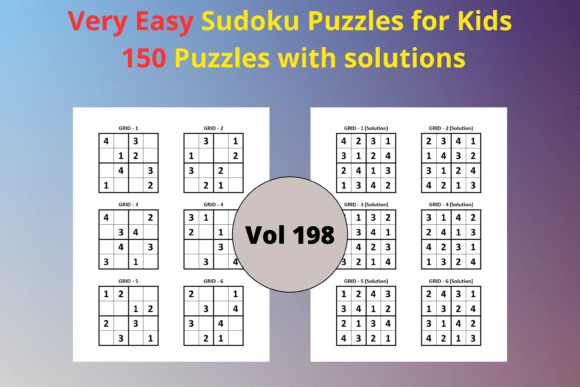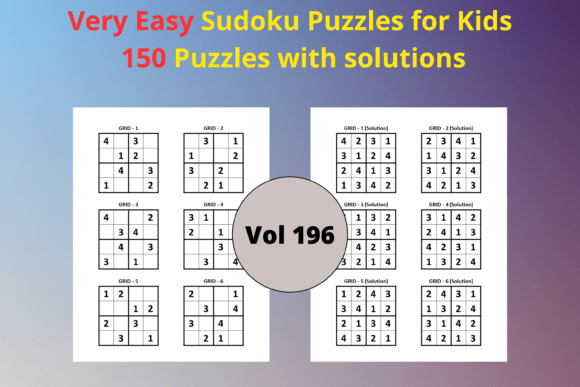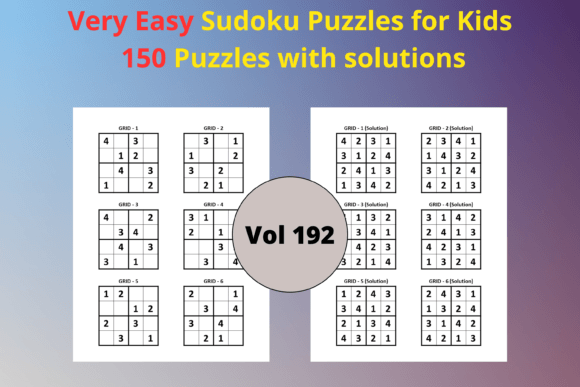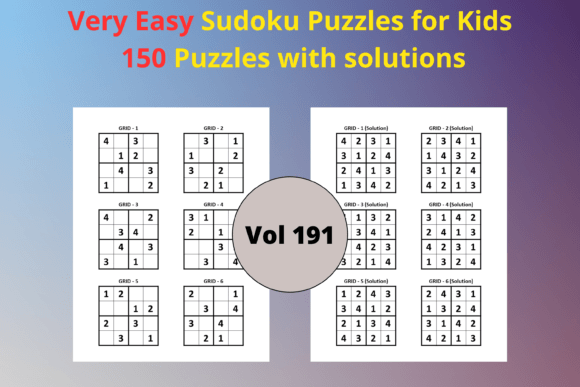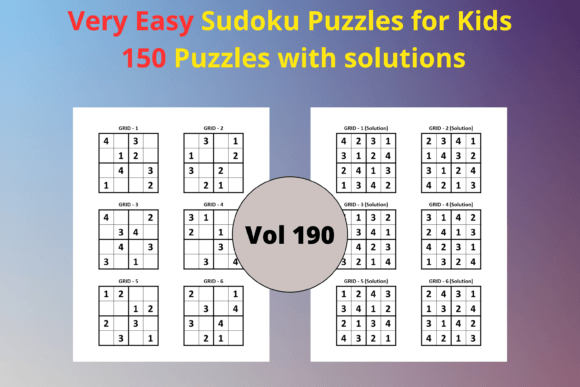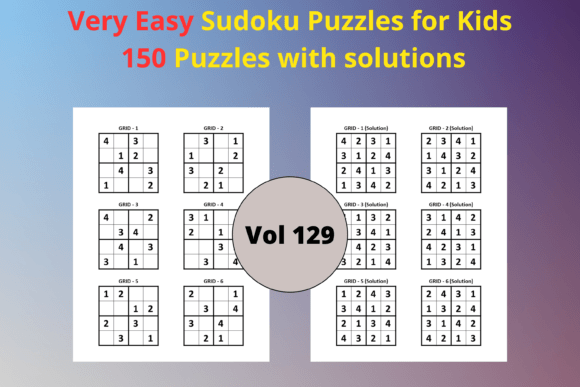
Very Easy Sudoku for Kids 129: 150 Easy 4×4 Puzzles
When you’re building a kids’ activity book from scratch, the math needs to be invisible. A child shouldn’t feel like they’re solving a puzzle — they should feel like they’re playing a game. That’s exactly what this very easy 4×4 Sudoku pack delivers. You get a clean, print-ready interior with 150 puzzles and 150 matching solutions, designed specifically for early learners who are meeting the grid for the first time. No tiny numbers, no overwhelming 9×9 grids, and no guesswork about page layout. Everything is sized at 8.5 × 11 inches, with plenty of whitespace so little hands can write comfortably. As a KDP interior, it gives you that rare mix of instant upload readiness and genuine editorial polish. You’re not just buying puzzle pages; you’re getting a full book skeleton that understands how young brains work.
Why a Separate Grid Changes Everything for Kids
Most adult Sudoku books force the solver to juggle possibilities entirely in their head. A 6-year-old doesn’t have that working memory yet. This pack uses the 4×4 grid — sixteen cells, four mini-blocks, and only the numbers 1 through 4. The magic isn’t just the reduced size, it’s how the page is constructed. Each puzzle sits in its own calm, uncluttered space. The grid lines are thick enough to separate regions clearly, but not so heavy that they distract. White margins breathe around every puzzle, which reduces visual stress and lets a child’s eye rest naturally on the task. When you’re editing the PPTX file, you can see how each page is a self-contained unit of concentration. There’s no forward-thinking required from the solver about what comes next, just one friendly puzzle at a time. This pacing is often overlooked in generic puzzle interiors, but it’s the single biggest reason these pages convert browsers into buyers for your KDP book.
What 150 Puzzles Actually Do for Your Book’s Value
Volume matters differently in kids’ publishing. A book with 50 puzzles feels thin and ends too soon. A book with 150 puzzles becomes a reliable companion. It’s enough to fill several road trips, quiet afternoons, or a whole term of classroom brain breaks. Parents notice this kind of staying power. When they flip through the “Look Inside” preview on Amazon, they’re silently counting pages and estimating how many days of peace they’ll get. This pack provides exactly that perception of abundance. The 150 solutions are placed in their own clear section with the same consistent layout, so there’s no awkward flipping. Each answer grid mirrors the puzzle grid’s scale, making it easy for a parent or teacher to check a page at a glance. And because these are very easy 4×4 puzzles, the progress is real: a child can work through a dozen without frustration, building confidence pattern by pattern.
The Visual Personality of a Beginner-Friendly Page
If you strip away decoration, what’s left is pure usability. The font used for the numbers inside the grids is deliberately simple — clean, generously sized, with open counters so 3 and 8 would never be confused (even though 8 doesn’t appear here, the design principle carries forward). This visual simplicity isn’t accidental; it’s the same discipline you see in well-designed early-reader books. The grid cells are spacious enough for a child’s large, sometimes wobbly pencil marks. Nothing is crammed. When you open the PowerPoint file, you’ll notice the entire puzzle area is centered vertically and horizontally, a small but important detail that signals professionalism to any parent or educator. These subtle cues tell the customer that someone who understands early childhood education touched this layout. The pack’s “edible” readiness means you can add themed illustrations or motivational stickers around the puzzle area without breaking the grid’s integrity — perfect for seasonal books or character-themed activity lines.
Where a 4×4 Sudoku Pack Fits Into Your Creative Business
Beyond the obvious KDP activity book, this interior works as a swiss-army content asset. Classroom teachers download similar sheets for math centers, special education sessions, and early-finisher activities. Children’s party planners use them as quiet table activities during birthday events. Subscription box curators slip them into monthly kids’ kits alongside crayons and stickers. Homeschool bloggers repackage sections into free printable lead magnets. If you’re running a print-on-demand store, the 8.5 × 11 trim size fits all major platforms without resizing headaches. The editable PPTX file means you can insert your brand colors, add a “Name” line at the top, or even re-sequence pages to create a progression from easiest to slightly more challenging (though all remain very easy, you can subtly cluster puzzles with more given numbers first). The commercial license clarification is built in: you’re free to use these pages in your own finished products and keep 100% of the royalties. No attribution, no ongoing fees, no style limitations. That’s the kind of transparency that professional publishers need to scale confidently.
How Puzzle Design Influences Trust and Repeat Customers
There’s a psychological thread that runs from a child’s first successful puzzle to a parent clicking “Buy Again” on your author page. The thread is predictability of experience. When every puzzle in the book consistently matches the “Very Easy” promise, parents stop pre-screening pages and start trusting your brand. This pack maintains that consistency by avoiding trick placements. Every 4×4 puzzle follows predictable logic: identify the missing number in a row, check the column, confirm the block. No advanced strategies required. This means the “very easy” label is accurate, not marketing fluff. For you as a publisher, accurate difficulty labeling reduces negative reviews and returns — a practical business concern that often gets overlooked when we talk about design. When the puzzle experience matches the cover promise exactly, your book earns the kind of quiet word-of-mouth recommendation that fuels long-tail KDP sales. The solution section adds another trust layer: families with non-native English speakers or parents who aren’t confident with math can simply verify answers without stress.
Practical Editing Tips for the PowerPoint File
Not everyone thinks in PDF. The included PPTX file gives you pixel-level control without needing InDesign or special plug-ins. Here’s how experienced designers use it: first, insert a blank slide at the beginning for your title page and copyright notice. Then add a brief illustrated guide showing a solved example — children under 7 often need this visual anchor. You can group a puzzle grid and copy it to create a “bonus” section of 10 extra puzzles at the end, a tactic that makes the product page feel over-delivered. If you’re planning multiple books (four seasons, different difficulty levels, themed collections), save your customized PPTX as a template. Change the color of the grid lines to match your cover’s palette — soft pastels for kindergarten themes, bolder primaries for general kids’ books. Because the underlying grid is fixed, your entire series will share visual DNA even as content changes. When testing, print a page and hand it to an actual 5-year-old. Watch where their hand covers the grid area. Adjust margins slightly if needed, then save that as your final master. This ground-level user testing costs nothing but pays back enormously in product reviews that mention “big, kid-friendly squares.”
Readability, Hierarchy, and the Invisible Grid
Every publisher knows that visual hierarchy isn’t just for landing pages — it applies deeply to printed activity books. In this interior, the hierarchy is instinctive: puzzle number sits small in the top-right corner, the main grid commands the center with the heaviest visual weight, and the solution grid mirrors that weight but is marked clearly with a “Solution” label. This establishes a reading path that moves from identification to action to verification, without a single instruction text. Even the whitespace acts as a silent breathing room, signaling that each puzzle is a fresh start. The font consistency across puzzle numbers and solution grids ensures that when a child turns the page, they recognize exactly what to do. No cognitive overhead. That’s the true test of a successful educational layout: it vanishes so the content can do its job. For your KDP book, this invisibility translates into higher page-flip engagement in the Amazon previewer — a metric that can improve conversion rates because potential buyers see a long, clean runtime of puzzles that their child can clearly handle.
Choosing the Right Interior for Your Next Kids’ Book Launch
When evaluating a puzzle pack like this, ignore the temptation to count only puzzle quantity. Look at the relationship between puzzle and page. Is the grid competing with decorative borders? Are solution pages easy to locate or buried in a clump? Does the PPTX file let you insert your own front matter without breaking the flow? This pack’s structure answers all three with a quiet confidence. There are no decorative distractions by default, making it a neutral canvas for whatever theme you have in mind — dinosaurs, mermaids, space, animals. The solutions are grouped but clearly separated, so you could even place them at the very back or intersperse them, depending on your style. The editable format means you aren’t locked into one single presentation. This flexibility is especially valuable if you’re testing different niches or book covers before committing to a large ad spend. You can spin up a “Unicorn Sudoku” version and a “Dragon Sudoku” version from the same core pages simply by swapping the cover and adding a few themed clip art elements near the puzzle, all while preserving the clean grid experience. That’s speed-to-market that a purely flat PDF can’t offer.
Real-World Results When You Prioritize Accuracy and Consistency
Imagine a parent opening your book on a Monday afternoon. Their 6-year-old completes three puzzles in a row, beams with pride, and asks to do “just one more.” That parent leaves a verified review talking about the quiet focus their child showed. Multiply that across hundreds of readers, and you have a catalog asset that sells itself. The foundation of that result sits inside these pages: puzzles that are truly very easy, solutions that are accurate, and a layout that feels generous rather than crowded. When you respect the child’s experience through thoughtful grid design and appropriate difficulty, your book shifts from a commodity to a go-to resource. This pack equips you with the raw material to make that shift happen quickly. Whether you’re an experienced publisher building a multi-book series or a creative business owner launching your first low-content product, starting with a proven, editable interior saves you the hidden cost of layout trial-and-error. The 150 puzzles give you room to experiment with sequencing, themes, and even marketing angles like “30 days of Sudoku” — and the 150 solutions ensure you’ll never scramble to verify a puzzle under review.