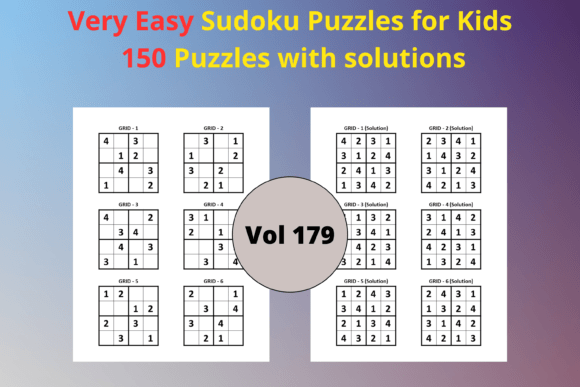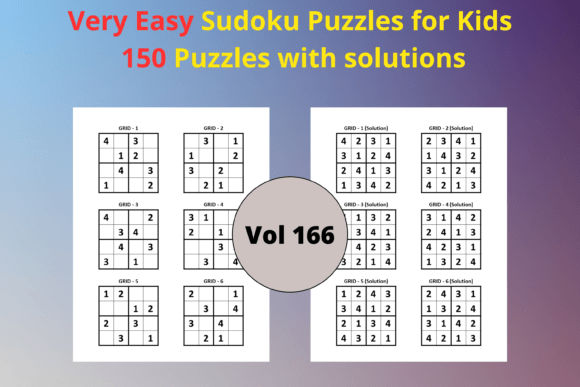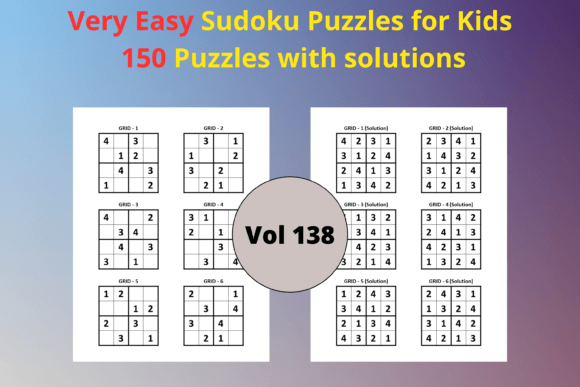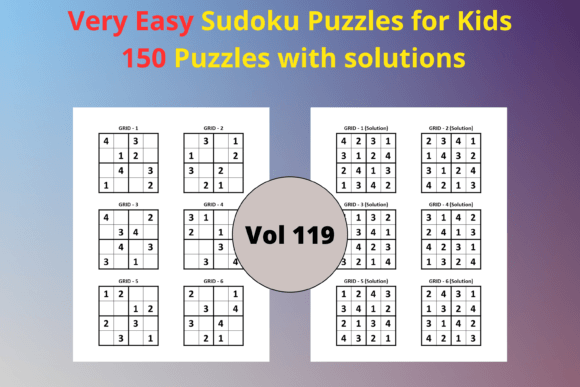
Unlocking Early Logic Skills with Very Easy Sudoku for Kids 122
The Gentle Introduction to Numerical Reasoning
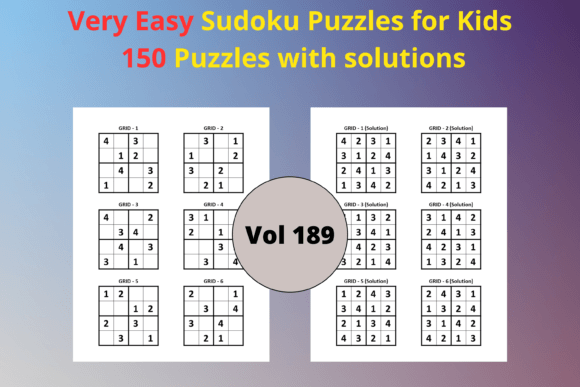
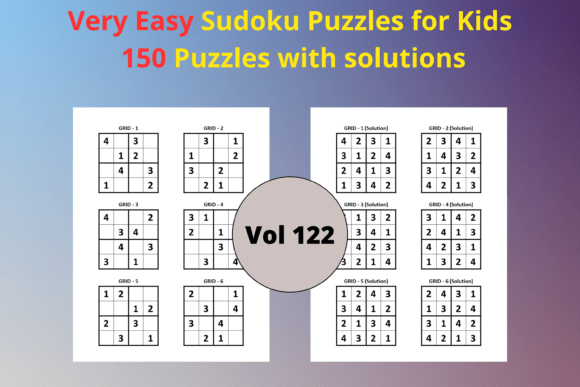
Children possess an innate curiosity for patterns. Long before they grasp formal arithmetic, their brains are wired to recognize sequences, spot differences, and delight in order emerging from chaos. Very Easy Sudoku for Kids 122 taps directly into this developmental window, offering a collection of 150 puzzles designed specifically for young solvers. These are not the intimidating 9x9 grids that adults wrestle with over morning coffee. Instead, each puzzle operates on a compact 4x4 grid, a format that transforms a complex logical exercise into an accessible, confidence-building activity.
The beauty of a 4x4 sudoku lies in its simplicity. With only the numbers 1 through 4 to place, children can focus on the core mechanic of deduction without feeling overwhelmed. Every row, column, and 2x2 subgrid must contain each digit exactly once. This constraint creates a manageable problem space where a child can hold the entire puzzle in their working memory. When a young learner places the final number and sees the completed grid, the sense of accomplishment is immediate and genuine.
Why 4x4 Puzzles Matter More Than You Think
The decision to start with a 4x4 grid is rooted in cognitive science. Working memory in early childhood has limited capacity, typically holding three to five items at once. A traditional 9x9 sudoku demands simultaneous tracking of dozens of possibilities across multiple rows, columns, and 3x3 boxes. That cognitive load can frustrate a five-year-old before they even begin. A 4x4 grid, by contrast, presents a challenge that stretches young minds without snapping their attention spans.
- Process of elimination becomes tangible when only four numbers are in play
- Visual scanning skills develop as children check rows and columns systematically
- Pattern recognition emerges naturally through repeated exposure to grid logic
- Frustration tolerance builds in a low-stakes, achievable environment
Educators and parents often notice that children who engage with very easy sudoku puzzles begin to approach other problems with greater patience. The habit of checking work—verifying that each row contains exactly one of each number—carries over into math homework and beyond. This metacognitive layer, the ability to self-monitor and correct errors, is one of the quiet gifts of puzzle practice.
Inside the 150-Puzzle Collection
This particular resource contains 150 very easy sudoku puzzles paired with 150 corresponding solution pages. The structure is intentional. Every puzzle sits on its own page, surrounded by generous white space that accommodates the sometimes-unsteady pencil grip of a young child. The solutions follow in a separate section, allowing a parent or teacher to check work quickly without flipping back and forth through a chaotic layout.
The editable PPTX file included in the pack opens up customization possibilities that a static PDF alone cannot offer. Teachers can add classroom instructions, insert school logos, or adjust the layout to match specific learning materials. The PDF version, meanwhile, is print-ready, formatted for standard 8.5 x 11 inch paper—the ubiquitous letter size that feeds through virtually every home and school printer without scaling issues. This dual-format approach acknowledges that different users have different workflows, and flexibility matters when you are preparing materials for children.
What Makes a Puzzle "Very Easy"
The classification "very easy" is not arbitrary. Each 4x4 puzzle in the set begins with a generous number of pre-filled cells, typically leaving only a few blanks for the child to complete. This high givens-to-blanks ratio ensures that every puzzle is solvable through direct deduction alone. No guessing is required, no candidate notation is necessary, and no advanced techniques like X-wings or swordfish lurk in the shadows. A child simply looks at the grid, identifies which number is missing from a row or column, and writes it in. The challenge lies in maintaining focus across all 150 puzzles, building stamina and reinforcing the logical habit.
The predictable difficulty curve across the set means that puzzle 1 feels similar to puzzle 122. Consistency is a feature here. Young children thrive on predictable structures—knowing what to expect reduces anxiety and allows deeper engagement with the task itself. When a puzzle collection varies too wildly in difficulty, early successes can quickly sour into frustration. This set avoids that pitfall entirely.
Educational Benefits Beyond the Grid
Sudoku is often framed as a math activity, but that label misses the true nature of the puzzle. No arithmetic is involved. A child does not add, subtract, multiply, or divide. Instead, they engage in pure logical reasoning. Distinguishing between these two cognitive domains helps parents and educators understand why a child who struggles with number bonds might excel at sudoku, and vice versa. The skills are complementary but distinct.
Research on early childhood cognition suggests that activities requiring sustained attention, rule-following, and sequential thinking strengthen executive function. Executive function encompasses the mental processes that enable self-control, flexible thinking, and working memory—all predictors of later academic success. A child sitting quietly with a sudoku puzzle is doing more than passing time; they are exercising the very neural circuits that will later support reading comprehension, scientific reasoning, and even social problem-solving.
- Spatial reasoning improves as children navigate the two-dimensional grid structure
- Pencil grip and fine motor skills develop through careful number writing in small cells
- Independence grows when a child realizes they can solve problems without adult intervention
- Persistence is cultivated through the satisfaction of completing increasingly long puzzle sessions
How Very Easy Sudoku for Kids 122 Fits Different Contexts
The versatility of a 150-puzzle collection makes it suitable for environments that extend far beyond the living room coffee table. Homeschooling parents often incorporate sudoku into morning basket routines, using a single puzzle as a gentle cognitive warm-up before transitioning into more demanding subjects. The activity signals to the brain that focused work has begun, functioning almost like a meditative transition ritual.
Classroom teachers in kindergarten through second grade find 4x4 sudoku ideal for independent work stations. While the teacher conducts small-group reading instruction, other students can engage with puzzles that require minimal guidance. The included solutions enable self-checking, fostering autonomy and reducing the constant refrain of "Is this right?" that echoes through primary classrooms. For after-school programs and childcare centers, the puzzles offer a quiet, screen-free activity that contrasts with the digital stimulation dominating so much of modern childhood.
Therapists and specialists working with children who have attention difficulties or learning differences also gravitate toward very easy sudoku. The structured, predictable nature of the task provides a calming framework. There is one correct answer, one clear endpoint, and a visual representation of completion. For children who find open-ended creative tasks overwhelming, this clarity is a relief.
KDP Interiors and the Self-Publishing Advantage
The product's design as a KDP interior reflects a growing trend in educational publishing. Kindle Direct Publishing has democratized the creation and distribution of learning materials. Instead of waiting for a traditional publisher to decide what children need, educators, parents, and content creators can produce targeted resources directly. This particular interior pack arrives ready to upload, eliminating the technical barriers that often deter would-be publishers. The heavy lifting of layout, formatting, and solution pairing is already complete.
The editable PPTX file adds another dimension. Entrepreneurs who wish to brand the puzzles, add their own instructions, or translate them into different languages can do so without starting from scratch. A French tutor, for example, could replace the English title page with a French equivalent and have a culturally appropriate resource ready in minutes. This adaptability makes the 150-puzzle pack a foundation upon which countless customized products can be built.
Practical Observations from Regular Use
Children do not experience sudoku the way adults do. An adult might approach a puzzle methodically, scanning for the most constrained cell and working outward. A five-year-old often begins with a number they like—perhaps the number 3 because they are three years old, or the number 1 because it is first. This personal, almost narrative approach to logical reasoning reveals how young minds weave meaning into abstract tasks. Honoring that approach, rather than immediately correcting it, preserves the child's intrinsic motivation.
Over time, with regular exposure to Very Easy Sudoku for Kids 122, something shifts. Children begin to notice that certain strategies work better than others. They discover that checking the row first, then the column, then the box, yields answers more reliably than random searching. This organic discovery of systematic thinking is far more powerful than a top-down lesson on "how to solve sudoku." The grid itself becomes the teacher, and the child becomes the discoverer of logical principles.
Parents report that their children start creating their own puzzles after completing several dozen from the book. A child who internalizes the rules well enough to design a valid grid has demonstrated mastery that transcends rote completion. Puzzle creation requires understanding constraints from the inside out—knowing not just how to fill a cell, but how to ensure exactly one solution exists. This creative extension is a natural next step that the puzzle pack implicitly encourages.
Solutions as a Learning Tool, Not a Shortcut
The inclusion of 150 solution pages might seem like an invitation to cheat, but with proper framing, solutions become a powerful educational instrument. When a child encounters a puzzle that truly stumps them—though rare in a very easy collection, it can happen—the solution page offers a chance for reverse engineering. A parent can cover the solution, reveal one cell at a time, and ask the child why that number belongs there. This guided discovery transforms a moment of potential frustration into a teachable opportunity.
Solutions also enable independent progress tracking. A child old enough to read numbers can compare their completed grid to the solution, circle any discrepancies, and attempt to understand where their reasoning diverged. This self-assessment loop builds metacognitive awareness that serves students well throughout their academic careers. The goal is not perfection on every puzzle; the goal is growth across 150 attempts.
Integrating Puzzles into Daily Routines
The volume of 150 puzzles invites creative scheduling. Some families adopt a one-puzzle-per-day rhythm, turning sudoku into a breakfast-table tradition that spans roughly five months. Others use the puzzles as a wind-down activity before bedtime, when screens are off but brains are still alert. The low cognitive demand of very easy puzzles makes them suitable for transitional moments—times when a child needs to shift gears between high-energy play and focused learning.
- Morning warm-up before homeschool lessons
- Restaurant or travel distraction that fits in a bag
- Rainy-day activity that requires no setup or cleanup
- Group challenge where siblings or classmates race gently
The physical format—8.5 x 11 inches with plenty of white space—means that even children who write large have room to work comfortably. No cramped cells, no microscopic numbers. This ergonomic consideration may seem minor, but anyone who has watched a kindergartner laboriously form a shaky numeral knows that spatial accommodations directly impact the quality of the experience.
For business owners and content creators exploring the children's activity book market, this interior pack represents a low-risk entry point. The very easy sudoku niche has consistent demand from parents searching for screen-free activities. The 4x4 format specifically targets an underserved segment—many sudoku books for kids jump too quickly to 6x6 or 9x9 grids, leaving the youngest puzzlers behind. Filling that gap with a well-formatted, print-ready product positions a KDP publisher favorably in search results and customer reviews alike.